When an opportunity arose for Craig and me to live on an island in Tonga for two months, we grabbed it. It wasn’t the island itself that inspired us to visit – it was the fact that the waters surrounding it were home to humpback whales.
From July to October, humpbacks arrive after a long journey from Antarctica. In the cold south, they’re eating, but in the warm waters around the Pacific islands, they’re bringing up their newborn calves in the safe, calm waters.
Tonga is one of the only countries in the world where you’re allowed to swim with these majestic giants, as long as strict rules are followed.
Our friend was the owner, guide and skipper of a whale swimming company which meant if she had space on the boat we could tag along.
Sadly, it wasn’t a great year for whales around the Ha’apai island group. Normally, the waters surrounding our island are described as ‘whale soup’ – because they’re so abundant, but this year was a challenge. Nobody knows why – but they suspect it was due to it being an El Niño year, affecting the water temperature for the whales.
In our two months, we went on six boat trips – most of them were at the start and end of the season as it was too busy to fit us onboard during the peak period.
The first boat trip was full of activity, starting with us following a couple of males. Craig and I have been on many whale trips but it’s always so exciting when we see their huge bodies rise out of the water like islands.
Males can be quite tricky to swim with as they’re moving more than the mums and calves, so we moved on and came across a calf that was repeatedly breaching.
They were moving a fair bit, though, so we ended up having our first swim with a different mum and calf chilling in a shallow area.
It wasn’t quite what I expected when we first saw them. The visibility wasn’t great and we could just see the large mum close to the sea floor, blocking the view of the baby. We bobbed on the surface and watched the mum spin around, revealing her pure white belly, before waving her pectoral fin and swimming away from us. They didn’t want to socialise, so we got back on board and tried again with some different whales.
In Tonga you’re only allowed four people plus a guide in the water with a whale, so for the next swim with a different mum and calf the group needed to alternate and Craig missed out which was such a shame as the first swim was pretty disappointing.
So I swam out with the others until we found the whales resting about fifteen meters below us. It was hard to figure out what we were looking at, as the shape and colour resembled a large black and white lump like a rock at the bottom of the sea.
We waited on the surface when suddenly the calf started swimming up for some air. Calves can only hold their breath for three to five minutes whereas the mum can last up to thirty minutes. So the great thing about swimming with a calf is that they are likely to come up more often so we can get a closer look at them.


She was so curious, coming precariously close to us. It was hard to manoeuvre my body with the buoyant wetsuit, especially when the guide shouted “GET BACK!” as she diverted straight for me.
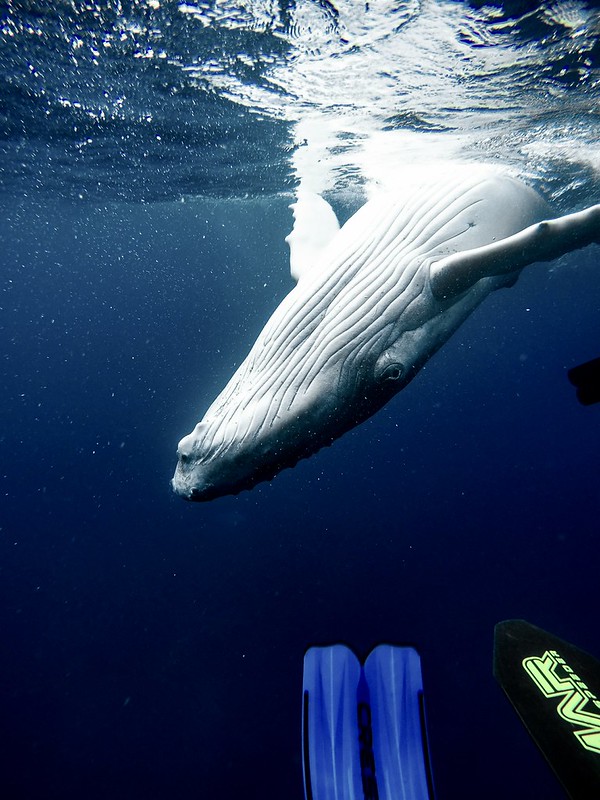

I was frantically kicking to get away from the whale but it was really hard to keep my head underwater and see the chaos unfolding at the same time. The playful calf spun around as I moved away, giving a flick of its tail just a meter away from me, as if to say “Hah! Made you scared”.

She dove down to her mum where they rested for a while, and then we saw the mum move her tail “Watch out, mum is coming up” said our guide. She did indeed swim up, surfacing just meters away from us and then swimming our way, staring into my eyes.

The calf was in front of her, and I watched in fascination as the mum positioned the calf on her head and pushed her towards us, like a kid demonstrating their show-and-tell item at school.


There were more frantic calls to get back – the rules in Tonga say you can get within five meters of a humpback, which is the length of their pectoral fin, but the whales don’t abide by the rule so we had to swim away to keep our distance.
It was a wild experience staring into the eye of a whale who felt completely safe in our presence. It was so much fun, but it was also hard to fully enjoy the moment without having Craig there. So I asked the guide if I could swim back to the boat to swap with him.

We tagged out, but by the time Craig got to the whales, they decided to swim away. Apparently, the American guest we had in the group dove down a bit, which is illegal in Tonga, and the mum didn’t like it, so she swished her tail to say “I’m done” before swimming off.
I was so gutted for Craig. One person’s selfish action caused the whale to feel uncomfortable and Craig to miss out on an incredible swim. The whales resurfaced again but the guide was pissed off with the American’s actions so to teach him a lesson he cut the trip short and we headed back.
A week later we got another chance and luckily it worked out great as we got to swim with another chilled mum and calf. They weren’t quite as playful as the first ones, but they were very calm and gentle moving which meant we had a really relaxed swim absorbing every moment.

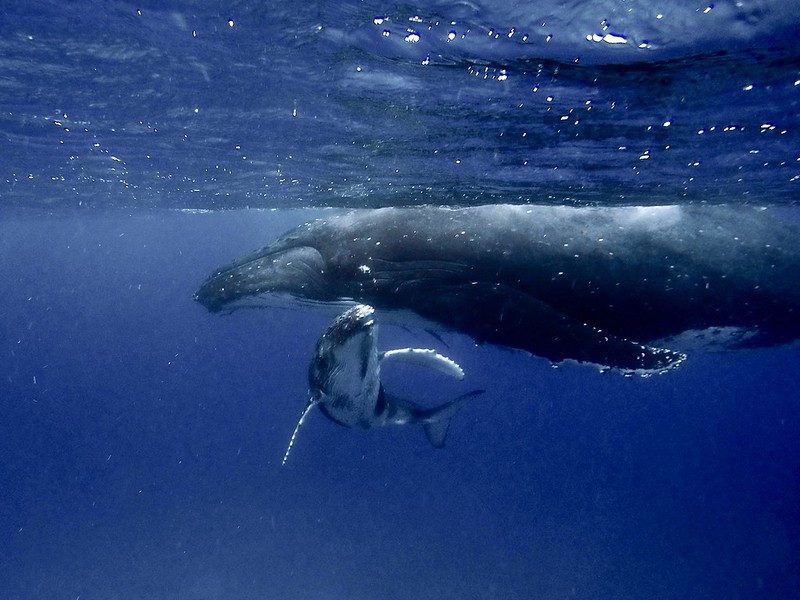

At one point the mum came up for air before slowly diving back down. It was a shallow area and it was so impressive seeing her floating vertically with her tail near the surface and her face near the floor – it helped give some scale to what we were witnessing. Female humpbacks can grow up to 16m long, roughly the same length as a city bus.


We spent forty-five minutes swimming with these gentle giants until they came up one last time, gliding right past us. The mum’s eyes were aimed in our direction as she casually glided past us with a final little wave of her pectoral fin before they vanished into the deep blue.
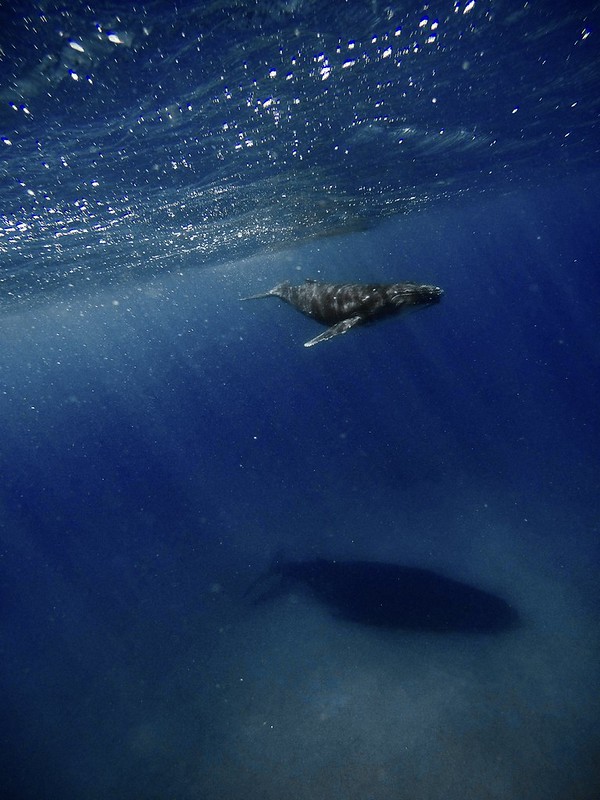


The next boat trip was in extremely rough conditions with very little success. But we did hear something special – “What’s that sound?” I said as we turned the music off and listened more carefully. It was a singing whale!
The guide took the guests into the water and while they didn’t spot the singer they heard him clearly underwater. It was crazy that we could hear it mildly on the boat too – but maybe it’s possible when you consider that underwater their songs can be heard up to 50km away and this whale was clearly very close by.
The following week we had another long day searching for whales for hours in rough seas. We were seasick and sunburnt as the boat rocked in the swell for six hours. It was in the final hour that we finally spotted some whales. We weren’t close to any but we could see their blows visible in different directions, along with some distant breaching. We began tracking alongside a mum and calf, hoping to swim with them but they were very much on a mission to get somewhere, so we didn’t get to swim. Ironically, the moment we arrived back on our island we saw the calf breaching repeatedly beside another boat – typical.
It’s such potluck with wildlife, and at the end of the season we headed out again – spotting an unusual sight as five humpbacks swam together. Ha’apai is known for being a haven for mums and calves so it was unusual to see four adults and one juvenile together.
When we got within swimming distance we headed into the vibrant, blue water. The visibility was incredible, with the reef about twenty meters below us. But the current and swell were strong so I was battling through the rough sea. Occasionally I’d look up to see the whales’ backs so I knew which direction to swim.
I’m not a great swimmer on the best of days, but these conditions were tough with waves sloshing like we were in a washing machine. Suddenly, after swimming as fast as I could for a fair few minutes I began struggling to breathe, panting frantically as I gasped for air.
Thankfully I’d brought a floaty along so I could rest on it to catch my breath; otherwise I’d have been close to drowning as my breathing turned so panicked. I was shattered and only just managed to witness two of the whales diving down in front of us while the others on the right were too quick to swim alongside.
We tried swimming with these whales four times, and it was exhausting. The boat would come and collect us after each swim and just trying to get back on board was a challenge – the boat seemed to be getting further away as I swam with all my might.
I had jelly legs when I got back on board, struggling to make them function before it was time to get in the water and try again. I got another brief glimpse of two whales but it wasn’t a very good swim. In fact at some point when we were swimming like mad, I looked back and saw my friend’s snorkel had snapped in half and she was trying to breathe with just the mouthpiece while big waves slapped in her face.
After the fourth attempt, we got back onboard and suddenly one of the whales breached not too far from our boat, but before its body slapped into the water a second whale breached, followed by a third and fourth. We were all whooping and cheering on the boat – shocked at what we were witnessing. They were like a group of majestic, synchronised swimmers who continued to do lazier breaches afterwards, with just the tops of their bodies coming out and smashing sideways into the water.
Our final boat trip was a complete flop with zero whales sighted. It was such a shame, but while I was chatting to the guest on board I spotted a fin gliding through the water a few meters away from the boat.
It was a shark so we cut the engine and when the guide said it was a hammerhead we all put our snorkels and flippers on, ready to go for a swim. Hammerheads aren’t aggressive towards humans and the awkward position of their mouth means that it would be unlikely for an attack to be deadly.
The guide and Craig jumped in first whilst the guest and I hesitated for a moment- the shark was a quick swimmer and the distance was becoming too much for me to swim. Sadly no one ended up seeing the hammerhead underwater, but it was cool to see it from the boat and as a consolation prize for no whale swims we took a snorkel along a nice area of reef.
Tonga was a place of extreme highs and lows – our luck was down to Mother Nature and it sucked when someone kept getting good swims while others didn’t. But that’s wildlife for you, and I’m so happy I finally had the chance to swim with humpback whales.

