While volunteering in Khuvsgul, Northern Mongolia, we learned a reindeer festival was happening not far from our camp.
The region further north of us was home to the Tsaatan nomadic reindeer herders and some of them come down to the lakeshore during summer to make a bit of extra money from tourism.
We were actually very lucky to visit a Tsaatan family thanks to a guest staying at our camp. He hired a private boat and our host asked if Craig and I could tag along. The boat ride was a beautiful trip on its own as we travelled over the most incredible, twinkly, blue water to access the other side of the lake.


After a short walk through the forest, we arrived at a clearing where three teepees, known as orts, were set up. A family lived there with half a dozen reindeer. They don’t usually eat the reindeer meat, as they’re used for milk, but if one passes away or needs to be killed they’ll eat the meat and that was all hung up inside a teepee.
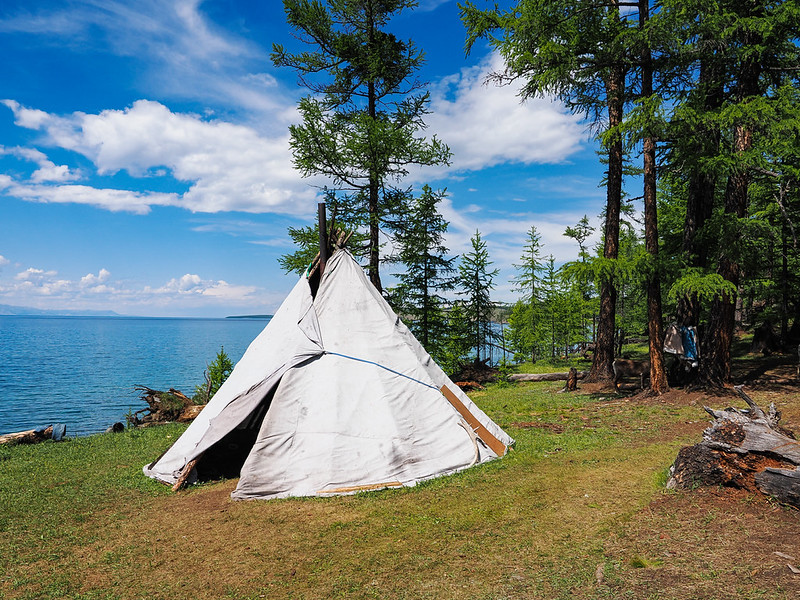


They had a table displaying carved antler key rings for sale, but there wasn’t much else going on. I found the culture fascinating though and wanted to learn more so we made sure to visit a reindeer festival that took place just 5km up the road from our camp.
It was just a small event which was perfect for us as I hate crowds. The schedule was all running about two hours behind, which we now know is a Mongolian thing – they have island time more than any island we’ve ever visited.


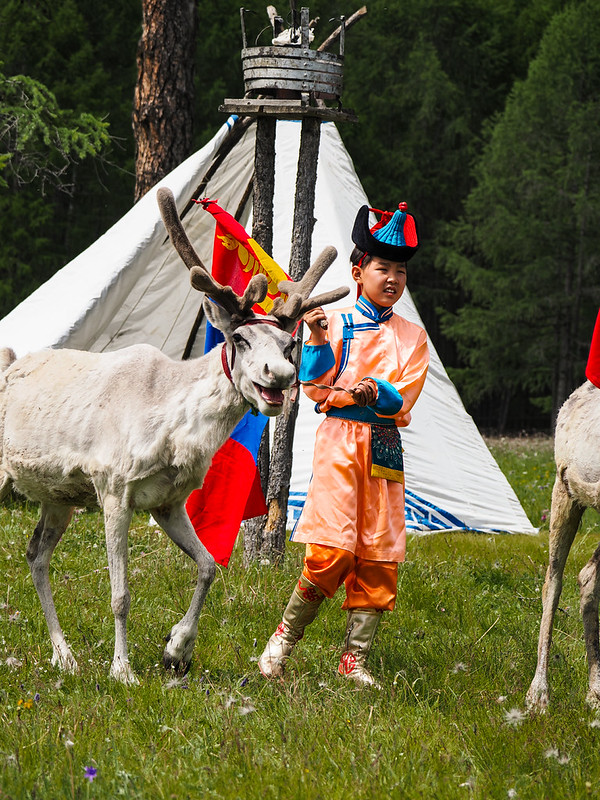
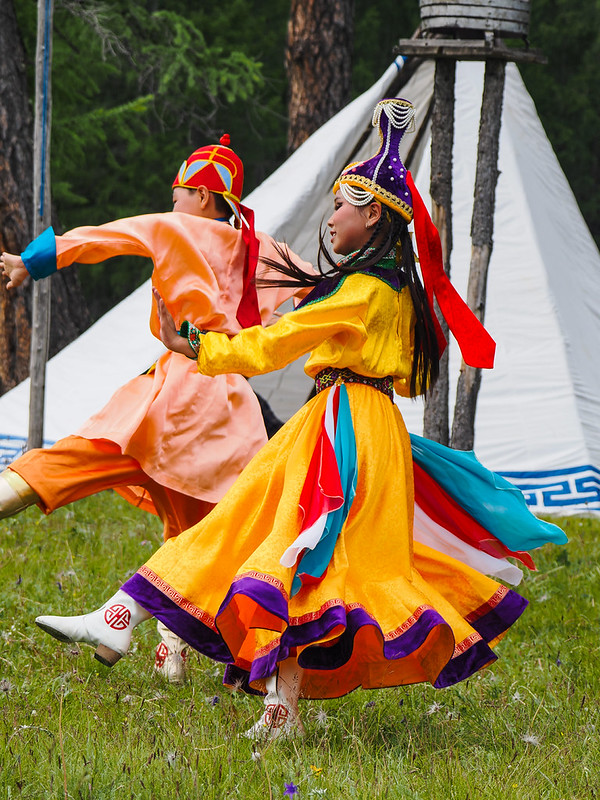
There were only about five reindeer at the event, who were paraded around by children dressed in fabulous silk outfits. The colourful costumes were for their dance performances which they put a lot of effort into and were a joy to watch.

While the festival was named after reindeer, there were actually only a couple of events involving them, and one was a competition to see who could dress up in a traditional robe known as a deel, strap a saddle to a reindeer and then put a kid onto its back before running to the finish line.
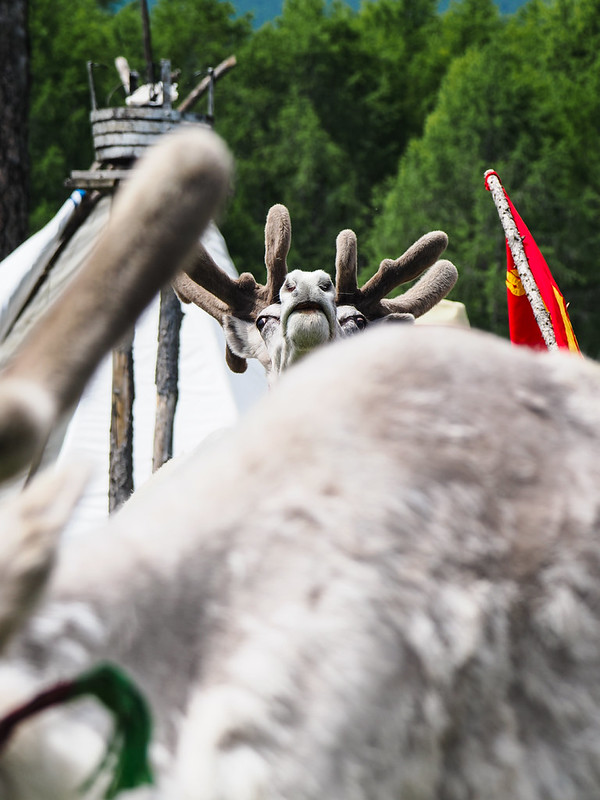

The kids were all small, except for one who was far too big for the task and we watched as he began falling sideways off the reindeer. The dad was frantically running alongside him, trying to prop him up. Technically he made it to the finish line before he’d totally fallen off and the crowd all cheered.
The Mongolian wrestling began in the afternoon which I was most excited about. The wrestling outfits were so unique – featuring leather boots, colourful underwear, and a strange sort of crop-top which covered their arms and shoulders but had an open-chest. Apparently the reason for the unique top is because many years ago a lady entered a wrestling competition disguised as a man and she won, causing the men so much embarrassment that they created a wrestling outfit that would be open-chested and thus, reveal if the opponent had breasts and was a women.

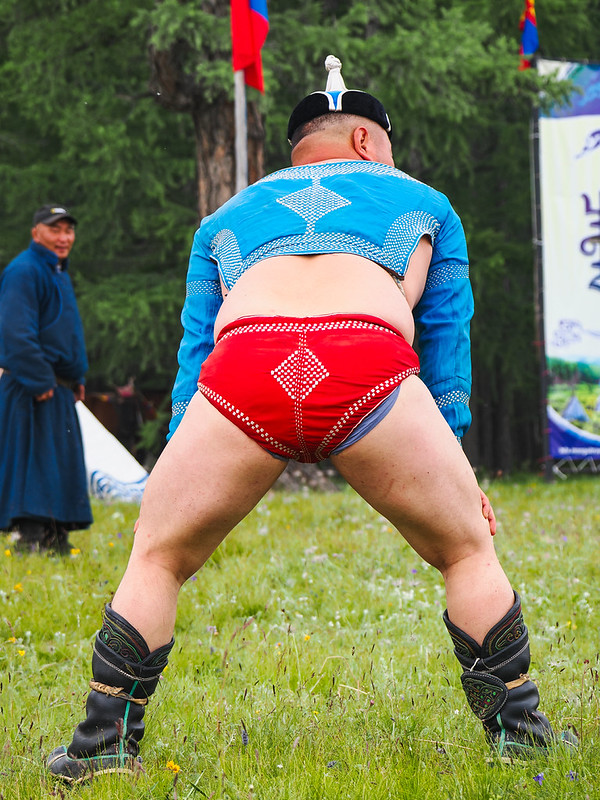
The rituals that were involved in the wrestling were fascinating. First the referee took the wrestlers fancy hat and then the wrestler performed a rather feminine dance, with one hand on the referees shoulder and the other out in the air as he pranced around the referee.

They wrestled members of the public and it seemed like whoever won received the fancy hat and became a future wrestler. But as it happened none of the public won, and each time a component was thrown to the ground they’d end the game by spanking each other’s bum. It was very humorous to witness.
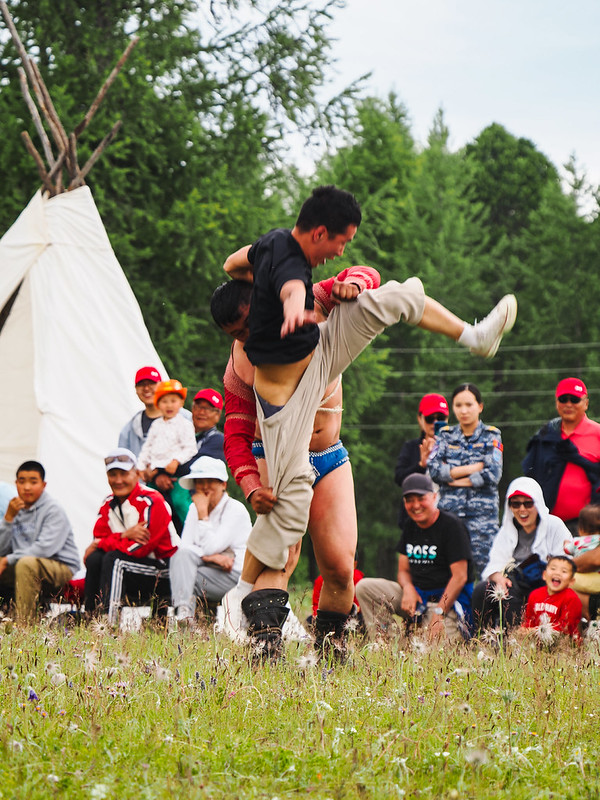
The wrestling went on for a long time though so we headed back to our camp to rest for a bit and eat some dinner before coming back out at dark to watch the shaman ceremony.
The sun had just set when we headed back out to hitch a ride 5km back to the festival. Hardly any cars were on the road and hitching was even more challenging because a couple of friends wanted to tag along. Somehow we managed to get a ride for all four of us, arriving just after the start time of 9pm.
In true Mongolian style, it didn’t start until 11 pm, which was way past my bedtime. A big bonfire was lit and then we waited for the ceremony to begin.
There were three shamans; one was Mongolian, and the other two were European which we hadn’t expected. They all dressed up in elaborate cloaks covered in shreds of fabric. The most distinctive part of their outfit was the mask, which was made out of wood. It was positioned atop their head, while their face was completely covered by strands of straw. Big black eyes, a nose, and a creepy smile, were painted onto the white mask and the top was covered in black feathers.

Each shaman had an assistant known as a Tushee, and their role was to translate and convey the messages spoken by the spirits while the shaman was in a trance. They also pre-warmed the drum before the ceremony began, and supported the shaman when they became physically exhausted.
Apparently people don’t choose to become a shaman – the role is usually forced upon them through a heavy physical and mental transition known as the “shaman’s illness”. They tend to get intense visions or seizures until they accept the vocation under an elder shaman’s guidance.
A shamans role is to act as an intermediary who connects the physical world with the spirit realm to provide healing and balance. They also assist with guiding the souls of people who have recently died safely to the afterlife.
It comes with risks though and performing rituals at cursed locations and accidentally contacting malevolent or demonic entities can provoke lingering, vengeful spirits to launch spiritual attacks or possess inhabitants.
The roaring fire lit up the scene of these three, masked shamans as the lead shaman stood up and began banging her drum. The Tushee held onto a bar on her back as the shaman began frantically twisting her body like she was possessed by the devil – maybe she was!
The other two shamans also began drumming and spinning around while a woman chanted something through a speaker. It only lasted about ten minutes before they calmed down and took a seat to sip bowls of vodka.
We weren’t sure what was going on so we asked a local in the crowd who told us that they tried contacting the spirits but none came forward tonight.
I was aware that hitching back would be even more challenging in the pitch black, so when we saw some people started to leave we took that as our sign. I’ve never hitched at midnight before but at least there were four of us for safety. Unsurprisingly, the few cars that passed us decided not to stop – and I don’t blame them; I wouldn’t either. So we walked about 3.5km before a car pulled over for us. A father and son were inside so the four of us happily squeezed into the back and were dropped off at our camp just as it poured down with rain.

