As soon as we arrived in the monastic town of Xiahe in Gansu, I just knew I’d love the place.
For starters – it’s the first place we’ve come across where some of the monks wore fuchsia pink robes. Many were still wearing the classic red ones, but the occasional pops of pink thrilled the photographer in me.

We checked into a Tibetan-run hotel which offered a fabulous view of the surrounding hills from the roof terrace. The kind host often encouraged us to take a beer that he couldn’t drink, and sit on the terrace to enjoy the view.
Many of the shops in town were selling Thangka art – a Tibetan Buddhist art form that can take years to complete. The shops all had studios inside, where we could watch the artists at work. One man was working on a huge piece, maybe 10ft wide. I asked him how long he’d been working on it and he spoke into my translator “Seven years, but it will take another year for it to be finished.”
I couldn’t help my curiosity and asked how much he would sell it for. “Six million dollars,” he said. We assumed he meant yuan, though, which is roughly £650,000, and still a wild amount for a painting, but not so much when you consider the time it took.
He was such a nice chap and began showing us photos of the first stages of the painting, stretching the cotton canvas onto a frame and beginning the pencil drawings. He picked certain drawings and then pointed to the painting, to show that part complete.
I would have loved to buy some of the art, but even the small pieces which were only 1.5 inches tall, sold for a whopping £160. It was out of my budget, but fascinating to see.
I fell in love a little more with the town when we discovered a Nepali restaurant. My goodness – I was craving a different flavour after a month of Chinese food. A couple of monks sat at the table next to us and were very excited to translate some questions for us.
The next day we set out to explore Labrang Monastery, founded in 1709. Before the Cultural Revolution, the monastery housed nearly 4000 monks. Numbers dropped drastically, but have now been capped at 1800 due to the monastery’s popularity amongst young disciples.
Labrang is one of the six great monasteries of the Gelug (Yellow Hat) school of Tibetan Buddhism and has the largest population of monks outside the Tibetan autonomous region.


It’s nestled in the valley at 2920m, and surrounded by arid peaks. The walk there from our hotel led us past lots of shops selling clothes and accessories for monks – ranging from mustard to maroon and then the unique Labrang shade of pink. They even sold the fabulous yellow headpieces and beautifully crafted velvet boots.
As we arrived at the entrance of the monastery, the place was humming with life. Tibetans were walking the 3km pilgrimage path around the complex and volunteers were handing out free yoghurt and fruits to everyone.

There was a 40 yuan (£4.40) entrance fee, which included an English-speaking guided tour that took us inside some buildings otherwise off-limits to tourists.

The guide was a lovely chap, and he took three Germans and us through the monastery and gave us so much information about Tibetan Buddhism and the monastery itself. He talked about reincarnation and how karma determines what your next life will be, and these are some of them:
There’s the Animal Realm, reacting solely by primal needs, such as fear, hunger and sleep.
The hungry ghost realm – Beings with massive stomachs but impossibly thin throats, meaning they can never eat and are tormented by constant cravings and hunger.
The Lama – considered an enlightened master. Unlike the six ordinary realms, the Lama (spiritual teacher) has broken free from the cycle of rebirth. They consciously choose to reincarnate back into the material world, purely to teach and guide others to enlightenment.
We watched as locals came into the halls to pray, many of them holding a tub of yak butter which they spooned out and added to copper bowls where candles flickered in the low light. We also saw locals pouring, or flicking water onto boxes of donated money, as a way of blessing it.
We entered a room designated to Tibetan Yak Butter Art, where the smell hit us before the actual artwork. The elaborate displays covered the walls – all created from Yak butter and natural pigments to colour it. The guide said each piece took 30 monks two months to make.

It was quite amusing because this traditional art form was being protected by modern air conditioning units, keeping the room cool so that the art pieces didn’t melt. Although I heard that in some situations they move the art outside into the sun to melt, as a symbolic way of showing that nothing lasts forever.

We were led into a hall with a giant Buddha statue, and intricate Thangka paintings covering the walls. But the highlight was visiting the main hall when the monks were heading in to pray.

Many of the monks were wearing the elaborate yellow headpieces, and they congregated outside before being called in. When it was time they all removed their velvet boots outside on the floor and entered the building. There were hundreds of identical boots strewn outside – I have no idea how they know whose are whose.


We were led around the edge of the building and then into rooms with large, stupas adorned with precious stones. Inside the stupas were the ashes of previously reincarnated lamas. The centre of the room was filled with monks sitting on the floor and chanting.

A few years ago China made a law that said you could not become a monk until you were over 18 years old – which was a huge knock back to Tibetan monks.
Amongst the men praying in the hall, were two young boys, maybe ten years old. I asked the guide how they were allowed at such a young age, and he said they were reincarnated lamas, so special rules were in place for these situations. The boys looked adorable in their oversized robes, giggling and waving at us. I’m still not sure how the boys were allowed to pass the strict law.
Tibetans were handing out monetary donations to the monks, and placing notes around the bases of the stupas and statues. It’s a strange thing to witness because the monks were receiving so much cash that they started putting it under the rug they were sitting on.
Once the tour was over, we were free to roam around the complex, we just couldn’t enter any buildings. I loved watching the pink-robed monks walking across the glaringly white courtyards and through the narrow, residential alleys where they lived.


We found an eatery just outside the monastery that was decorated with beautiful Tibetan artwork, and filled with locals. It was the perfect spot to people-watch and fill our bellies before we continued our explorations by walking the 3km kora.
Some locals were taking the kora to the next level, by prostrating their way around. They raised their hands in a prayer position above their head before lying flat to the ground. They take the prostrating very seriously, often purchasing special clothing for it. Sometimes they’ll wear a plastic, butcher-style apron, or a gingham-printed cotton overall to protect their outfits from the dusty floor.

They also sell hand pads to help them glide along the floor, and knee pads too. It’s a crazy workout – with people often having thick grey circles of dust layered on their forehead from the hundreds of times they bowed their head to the floor. It’s even more remarkable when we witness people prostrating in their 70s or 80s, pushing their bodies to the limits.


After completing the inner kora, we set off on a very hot walk around the outer kora, which leads pilgrims over the hills behind the monastery.

The grassy floor had turned white at the top, where pilgrims threw paper offerings into the windy air.
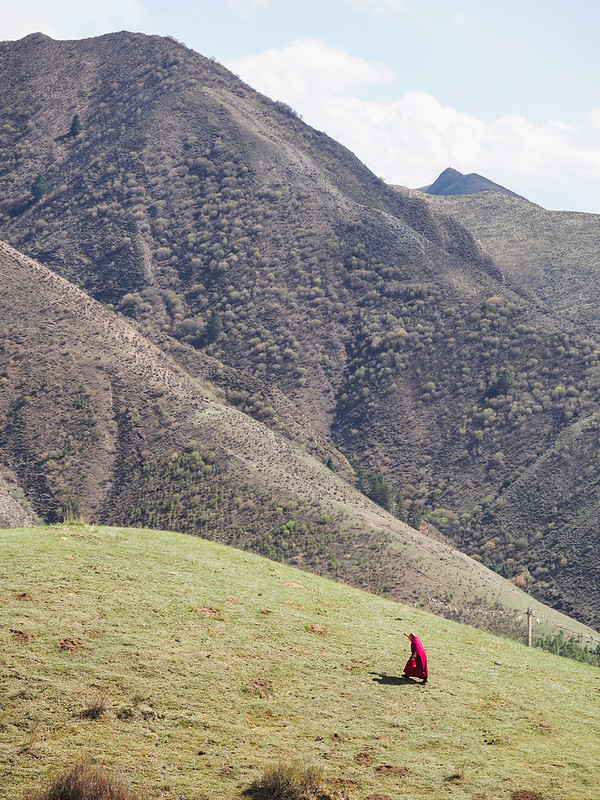

As we descended back down towards the monastery, we were treated to a Tibetan man singing a traditional song at the top of his lungs, the sound echoing through the valley.


The following day we wanted to explore the Ganjia grasslands area, where a remote monastery was located. Our friendly Tibetan host offered to take us for free, which was ever so kind, so we set off on a little adventure. Sadly, when we were just 10km from the monastery, Chinese security guards said we had to turn back and go the other way around. This meant we’d have to pay £9 per person as this route went via a paid ancient town which we weren’t even interested in visiting. It was such a shame to drive all that way for nothing, so our host encouraged us up a hill, where we could at least get a distant view of the monastery and the cool mountains and gorge that rose behind it.


Seeing as our day was cut short, we opted to stroll up a random valley near the monastery in Xiahe. There was a cluster of simple houses on the right side of the river, and a monk began waving us over. We didn’t know why he was calling for us, but we decided to find out.
The smiley monk invited us into his humble abode, where he sat down in camping chairs in a sort of conservatory with an astroturf floor and white fabric draped across the ceiling.
He then vanished into a back room, returning with a huge tub of yak yoghurt and three bowls. He wiped the bowls clean using his maroon robe, before spooning us massive servings of yoghurt. I was nervous that it wouldn’t be to my taste, but it turned out to be delicious, and just sweet for me.
We weren’t really sure why we were in this monk’s house but it was such a bizarre and funny experience eating yak yoghurt with him. He then pulled out a plastic bowl of slightly murky water from under Craig’s chair, took off his socks and soaked his feet in the bowl. It was like a funny game of ‘guess my next move’.
The monk didn’t speak any Chinese so we weren’t able to communicate at all, but there were a lot of smiles and hand gestures to keep the lack of conversation going. The monk also had us repeating words that he said, giving us the thumbs up when we pronounced them properly.
I had barely eaten half my yoghurt when the monk offered more, I couldn’t take any more, but the monk was very proud that he managed two bowls himself. He then proceeded to swipe the edges of the bowl with his finger, licking it clean until the bowl looked like it had been washed in a machine. That’s when I became a little worried – maybe that’s how he cleaned all of his bowls and cutlery and we were eating from a licked bowl. I tried to put the thought aside because he was so damn cute.
After the yoghurt, we were told to sit on the floor, and he came into the room with a fancy, metal, teapot that had peacock feathers stuck into the top, along with a metal object shaped like the number eight, and a bell – We were unexpectedly about to be blessed!
The monk put the metal object in one hand, and dinged the bell in the other, while chanting a mantra. He then poured whatever liquid was in the teapot onto our heads, and then a little in our hands, gesturing for us to slurp it up and then spit it out. He then poured more liquid on our heads, and in our hands again, this time saying to swallow it. I had no idea where the water was from so I had to do a bit of a fake swallow, not wanting to get a water-borne illness. There was one more pour of water before the blessing was complete. It was such a lovely, authentic and unexpected experience and one that I’ll treasure.
There was one last thing I wanted to do in Xiahe, and that was buy some coral and emerald beads. The sweet owner of the shop added them to my favourite necklace, so it’s something I can wear and treasure. I really loved this town and I’m so happy we could spend a few days exploring the area.

