Getting to the Tibetan town of Langmusi proved to be a little more challenging than we’d expected. From Songpan, in Sichuan, we took a bus north to Zoige, where we were informed there weren’t any buses to Langmusi, instead, we’d have to take a shared taxi.
We didn’t mind, but we had to wait almost an hour in the bus station which oozed of ammonia. After a trip to the toilets I realised why it was so bad – there were long-drop loos within the building, and they were full to the brim, so the pungent aroma seeped through the corridors and filled the entire bus station.
The shared taxi didn’t take all the way to Langmusi, it stopped about 15km away, and just before we got to the drop-off location, the other passenger requested to be taken directly to her house. This involved the most outrageously rough dirt road where our 2wd car was bouncing from side to side as the driver navigated his way around huge potholes and piles of dirt. On the plus side, the crazy route led us past a group of vultures standing right beside the road. We often see them flying, so it was great to see them so close up and appreciate their 3meter wingspan.
For the final leg of the journey we transferred to a taxi, and after many hours we arrived in Langmusi which sits on the border of Sichuan and Gansu – separated by the White Dragon River. The town is 91% Tibetan, the remainder is a mix of Han Chinese and Hui Muslims – so we got to see a colourful mosque along with the Buddhist monasteries.

The location was stunning as the town was encircled by jagged peaks and narrow gorges. One thing that was a huge eyesore, however, was the large concrete pillars marking the progress of the future high-speed railway.


We had a view of snowcapped peaks from our hotel window and the views got even better once we took a stroll through the town which had a Wild West vibe with Tibetan men wearing cowboy hats.
When I said “Tashi Dalek” which translates to ‘May all good things come to you’ to a Tibetan lady, she slammed on her brakes with a look of confusion on her face. Then she beamed a huge smile and shook my hand which was very sweet – I guess they don’t get many Western tourists visiting, let alone ones that greet them in their language.
We arrived in the evening so we just took a little stroll through the town, admiring a wall of red rocks glowing in the low sun, while jagged peaks rose on the other side.
The following morning we excitedly set off to explore Kerti Gompa, the monastery on the Sichuan side. The monastery was built in 1413 with six temples and colleges and was home to around 700 monks.
We began our exploration with a stroll up the hill to get a vantage point across the entire complex and the mountains that surrounded it. The stroll was going well until some dogs appeared out of nowhere, barking aggressively and causing us to back away and scurry down the hill.


A series of alleys led us past buildings, draped in fabric which swayed in the wind. One of the large halls was locked, but a young monk happily opened it for us and followed us around while talking to us through a translator.


He was in his twenties and had been a monk since he was ten years old – which isn’t possible anymore as a law came into place a few years ago saying that you can’t become a monk in China until you are 18 years old.
The boy kept sticking his tongue out at us, at first I was confused, but then I remembered it was a Tibetan tradition, and sticking your tongue out is a polite gesture and a sign of respect or agreement.
The monk told us if we returned that evening we could see the monks having political debates, which is something I really wanted to witness.

One thing we noticed about the monastery was the lack of toilets and the monks were weeing in public. Their large robes completely covered them, but whenever a monk was squatting down it meant they were weeing. It was kind of strange that it was allowed to pee at such a sacred place. Sometimes they went over drains, and other times just on the gravelly ground. To be fair it didn’t smell, and they must have a toilet somewhere for number twos – but if they’re similar to the ones I’ve used in monasteries before then the condition can be pretty bad and I’m not surprised they avoid using them for wees.


We arrived at a red-walled building where Tibetans were walking a Kora around it, some stopping to prostrate in front of the entrance. It’s the first time we’ve seen people prostrating, where they raise their hands in a prayer position above their head before lying face-down on the floor, it really shows their devotion as it takes a lot of energy and is like a full-body workout. It’s taken very seriously – with shops selling knee and hand pads, along with overalls or aprons to protect their outfits from the dusty floor.


The monastery gradually faded into nature, where we followed a meandering river past prayer wheels powered by the water. The route led us into Namo Gorge which was a narrow, rocky chasm, but the beauty came once the gorge opened up, revealing a dry meadow encircled by pointy peaks. Herds of sheep grazed the land while the Tibetan shepherd watched from a nearby hill. He lived in a canvas tent positioned at the bottom of the gorge, complete with a little stove and blankets.

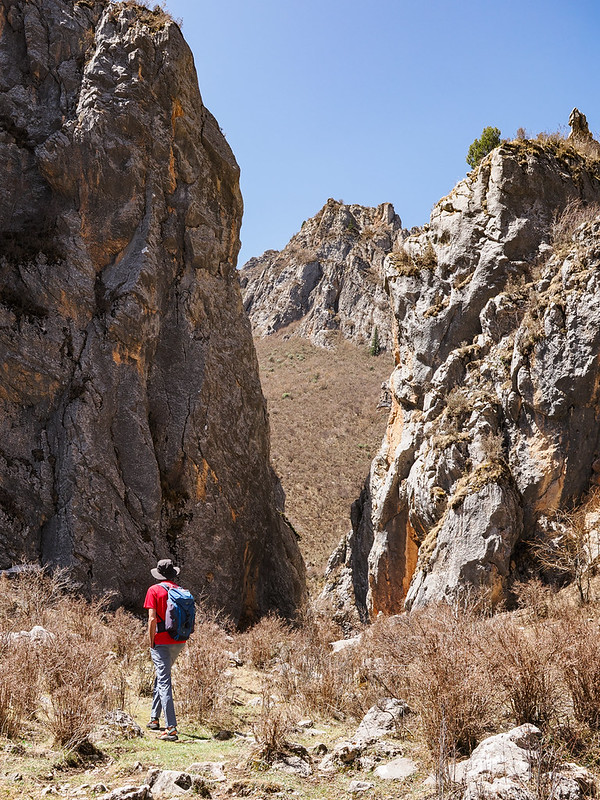
The path split left and right so we explored both valleys, hopping over streams and gawping at the rocky peaks that surrounded us. Marmots called the area home and we often paused to watch them appearing from their holes in the ground and having stand-offs with other marmots.


After a couple of hours in the gorge, we followed the river back to the monastery. Young monks wrapped their robes around their waists while they washed and frolicked in the water, their heads and faces white with foamy soap.

We walked the pilgrimage route around a large, red complex, where I was able to capture more photos of the locals praying, and monks wearing the large, yellow, headpieces.


We did return in the evening, when we saw 100 monks making their way across the courtyard into a hall where they sat down in long, curved rows. The monk in charge sat at the front, chanting a mantra in an extremely low and deep voice. We positioned ourselves on the steps outside and listened for a while but we didn’t see any philosophical debates take place, maybe we were in the wrong hall.

The following day we explored Serti Gompa, on the Gansu side of town. This side had a lot more activity going on amongst the monks. We also noticed that the monks wore lovely, black, velvet boots, whereas in the other monastery they all wore trainers.


We were welcomed into a prayer hall, where monks sat in neat lines, praying and drinking milk tea. The next hall we entered had men drumming, playing horns and tapping metal plates like symbols. The drums were held in one hand and hit with a long, bent stick with a cushioned end – sometimes used to hit their friends as a joke.


We spent a while sitting outside a yellow-walled hall, watching the Tibetans walk around the building. Along the edge of the wall were abacus bead counters on tables so they could keep track of how many laps they’d done. Many aim to do 108 laps as it’s considered good luck for Tibetan Buddhists.


After exploring the monastery we planned to continue walking up the hill to a Sky Burial site. This is where the sacred funeral processions take place, where the body is fed to the vultures, and from what I read it was the only one where tourists could still visit.
Sadly, tourists without any common decency or morals have previously visited and taken graphic photos of decapitated bodies and posted them on their blogs which is disgraceful behaviour. I suspect that was the reason for us coming across a man stationed at the bottom of the track, preventing us from visiting the site.
A Sky Burial is considered to be the final sacrifice, offering your body back to nature. Up on the high Tibetan plateau trees don’t grow above a certain altitude and the ground can be frozen for much of the year, making traditional burials and cremation impossible. Thus – a Sky Burial is a very practical funeral choice for Tibetans.
In rural areas, the body is sometimes just placed on the mountain for the vultures to consume, but in other spots such as Langmusi, the traditions are a bit more elaborate.
The body of the deceased is kept in a seated position for the first 24 hours whilst the prayers are recited, and the body is washed before being wrapped in a white cloth.
I’ve read a few different versions of what happens next, but either way things get a lot more gruesome – the spine is broken, so that the body can be folded up and carried up the mountain. At dawn the next day a monk whose designated job is the burial master takes over.
He proceeds to slice the body open, removing the organs and then cutting the body into smaller pieces, making it easier for the vultures to devour.
I also read that some burial masters crush up parts of the body and mix it with a grain to make it more palatable. Either way, it’s a pretty gruesome job, but an important one for Tibetans.
Apparently, when the Sky Burial site could be visited, people were coming across lone limbs and scalped heads. There were also burnt patches on the floor with charred skeletons because in Langmusi they burn whatever is left after the vultures have eaten.
We continued our stroll along the quiet lane that led us past some bones and what appeared to be a leathery hand and forearm. We were a few hundred meters from the burial site so it was hard to know if we were looking at a glove or a human hand – the vultures could have easily flown off with parts of the body and dropped them in the nearby hills.


Slowly, we ventured back to town alongside the river, passing herds of yaks and occasional marmots who were unfortunately squished along the roadside.
After several days exploring Langmusi, it was time for us to head to a new area of China. I’m really glad we visited before the high-speed railway was completed as I suspect the quaint town will soon be filled with large Chinese tour groups and lose its charm.

